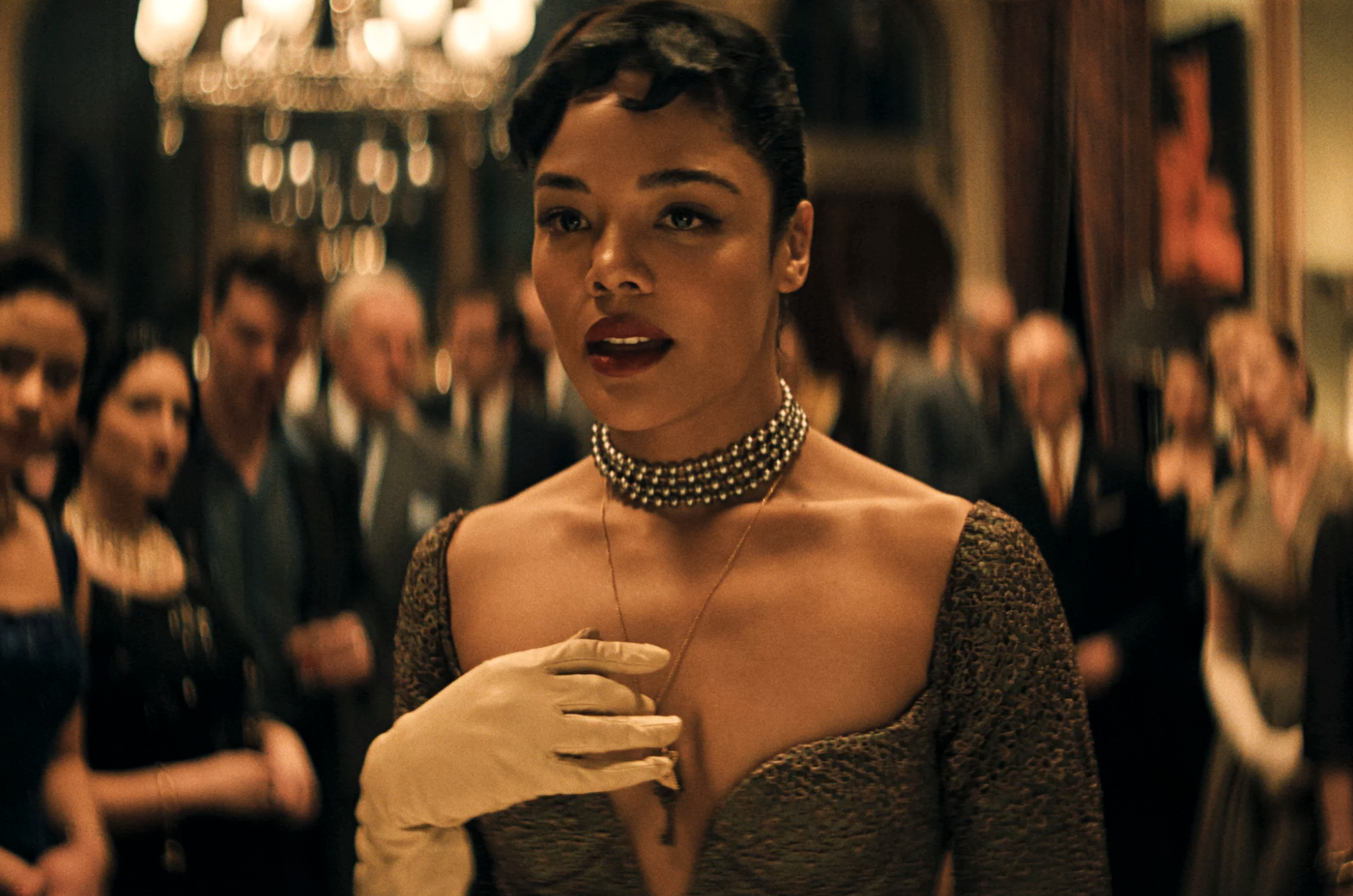
Before entering the hellish world of the 28 Years Later franchise, Nia DaCosta invites us to an affluent gala hosted by the devilish Hedda, played by Tessa Thompson. What did Kevin think of the film? Check out his full review below.
#Hedda #MovieReview
“Henrik Ibsen’s renowned stage drama from 1891 is reimagined in an epic and emotional way.”
By Kevin Muller
In literature and film, whenever a group of rich, entitled people gather for a lavish party, nothing good ever comes of it. These soirées tend to expose greed, envy, and humanity’s ugliest impulses. Adapting Henrik Ibsen’s Hedda Gabler, writer-director Nia DaCosta crafts a toxic social gathering that examines women’s struggles in love, power, and ambition – all wrapped in a juicy, dramatic package.
Thompson stars as Hedda, who throws an extravagant party to help solidify her husband George’s position at a university. Early on, conversation swirls around an unseen woman named Eileen, a potential rival for the job. The tension is immediate, made more potent by the fact that Hedda and Eileen share an unresolved past. Eileen is on the brink of publishing a manuscript expected to make waves in the academic world, aided by Thea (Imogen Poots), who is also romantically involved with her.
When Nina Hoss finally arrives as Eileen, she takes command of the film. Brash, fearless, and uninterested in conforming to societal expectations, Eileen is everything Hedda both desires and resents. Hoss brings a fiery intelligence, razor-sharp wit, and effortless sensuality to the role. DaCosta communicates Hedda’s obsession through striking visual language – particularly a breathtaking moment when Hedda first sees Eileen enter the party – captured by cinematographer Sean Bobbitt and underscored by Hildur Guðnadóttir’s radiant score.
The production design gives the film a warm, elegant glow. The classic sets are a pleasure to take in, and it’s exciting to know this same creative team will reunite with DaCosta for 28 Years Later: The Bone Temple. Here, though, the monster isn’t supernatural – it’s Hedda herself. Thompson revels in the character’s narcissism, manipulation, and emotional volatility. With a sly smile and cutting sarcasm, she dominates every room, making Hedda endlessly watchable even as she spirals toward self-destruction.
At its core, Hedda examines how women sabotage one another – even when one is on the verge of breaking through the glass ceiling. While men occupy the edges of the story, the emotional center belongs to Hedda, Eileen, and Thea. Eileen draws power from her intellectual achievement, Thea from love and loyalty, and Hedda masks her insecurities behind wealth and entitlement. Each is ultimately undone by her own emotional needs and by her relationship to the others. DaCosta and her cast make this painfully clear across the film’s near two-hour runtime.
Though the story’s themes are familiar, Hedda feels fresh under DaCosta’s confident direction. It’s a visually rich, emotionally charged adaptation that breathes new life into a classic work and reinforces why DaCosta remains one of the most compelling filmmakers working today.
I am giving Hedda a 3.5 out of 5 Hairpieces!
 Cinephellas